1959-1967: John Tanburn - home meetings and erecting the church building
John Tanburn came as vicar in July 1959. As he settled into the Vicarage John
Tanburn asked the PCC for help with the state of the Vicarage garden which was
very rough and dangerous for children - money was offered for re-turfing. From
this it is evident that the physical conditions around were still very basic and
crude.
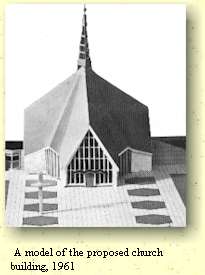 In July 1961, proposals for the new church were unveiled. The
design is very similar in many ways to what was in fact built, but the most
obvious difference is that the entrance path leads straight from the road into
the church. This design was changed later, so that entry would be into a narthex
before going on into the church - the hope was that this would mean that noisy
greetings could take place in the narthex, not in the actual worship area, a
hope that has perhaps been about 70% successful!
In July 1961, proposals for the new church were unveiled. The
design is very similar in many ways to what was in fact built, but the most
obvious difference is that the entrance path leads straight from the road into
the church. This design was changed later, so that entry would be into a narthex
before going on into the church - the hope was that this would mean that noisy
greetings could take place in the narthex, not in the actual worship area, a
hope that has perhaps been about 70% successful!
The proposals stress that the design started with the
ground-plan - evaluating what a church building is for, what different features
were needed, and how those features should relate together at ground level. This
approach was absolutely fundamental in giving us the very usable interior that
we have today.
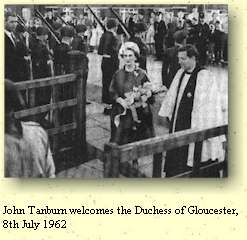 However, presenting plans is one thing, seeing them
implemented is another, and there were many frustrating delays throughout this
period. The foundation stone was laid on 8 July 1962 by the Duchess of
Gloucester, but delays soon started, and in fact little work was done for the
rest of year, largely because of confusion over the likely cost.
However, presenting plans is one thing, seeing them
implemented is another, and there were many frustrating delays throughout this
period. The foundation stone was laid on 8 July 1962 by the Duchess of
Gloucester, but delays soon started, and in fact little work was done for the
rest of year, largely because of confusion over the likely cost.
If the laying of the foundation stone was seen as a physical
milestone in the life of the church, a spiritual milestone was the start in
October of nine area Home Meetings. The parish was subdivided into nine smaller
sub-parishes, each centred on the home of a member of the church. They were
encouraged to visit the homes in their area, so that the Home Meeting was not
just a cosy group of Christians but had a real evangelistic thrust.
Leadership of the groups was mainly lay. The aim was that the
groups should grow and subdivide, and that in the course of time they should
develop into house churches that would eventually run their own children’s
groups.
This was a truly radical vision for developing house churches and was
virtually a new idea for any Church of England parish. It was given wider
currency by the book "Open House" that John Tanburn wrote a few years
later, describing what had been done here at St Barnabas.
Today, we still have home meetings, with a very high proportion of church
members belonging to them. They are not, however, organized on a geographical
basis and so lack one of the main features of John Tanburn’s house churches.
They do not have the evangelistic thrust that his groups had, but they may be
more effective in terms of fellowship and support between members due to them
meeting weekly or fortnightly, rather than monthly. Clearly there is room here
for further thought about the function of groups in the life of the church.
Previous | Next
| Introduction